Channel/Noise Estimation
This notebook demonstrates an end-to-end pipeline for channel and noise estimation using the PDSCH class’s estimateChannel method.
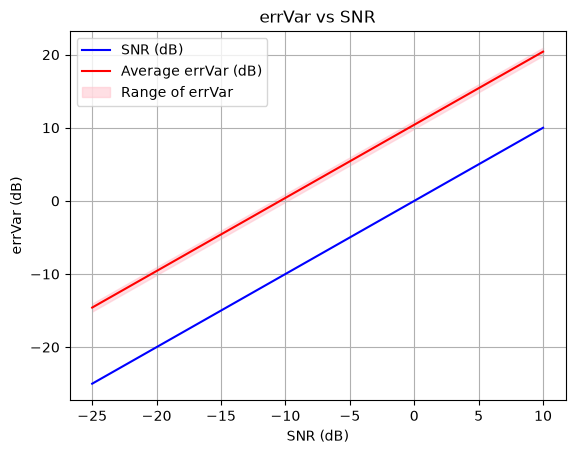
The estimateChannel function estimates the effective channel between the PDSCH layers and the receive antennas using the DMRS resource elements. It also returns errVar, which is the variance of the effective residual uncertainty associated with the estimated channel. If the optional parameter estimateNoiseVar is set to True, the function also returns an estimated noise variance.
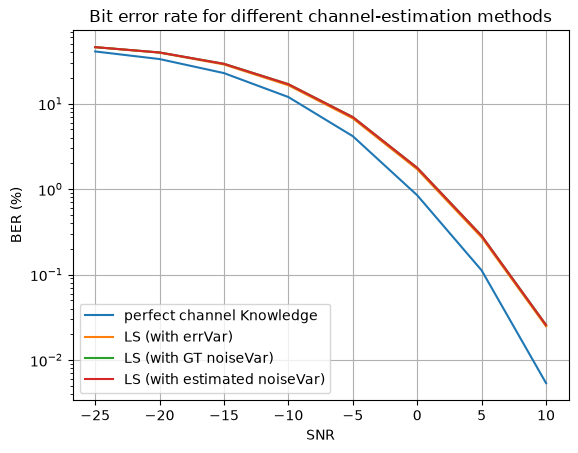
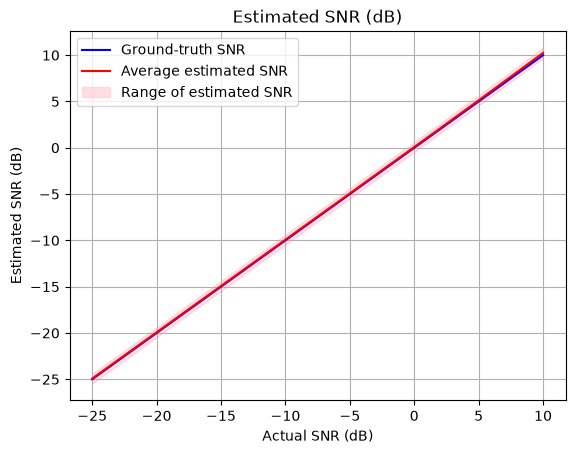
This notebook compares several channel- and noise-estimation methods and evaluates their corresponding bit error rates. It also compares the estimated SNR values with the ground-truth SNR values.
[1]:
import numpy as np
import time
import matplotlib.pyplot as plt

from neoradium import Carrier, PDSCH, CdlChannel, AntennaPanel, random
from neoradium.utils import toDb
[2]:
snrDbs = [-25, -20, -15, -10, -5, 0, 5, 10] # SNR values (in dB) for which we want to evaluate the model
freqDomain = True                           # Set to False to apply channel in the time domain

modulation = "16QAM"                        # Modulation scheme
carrier = Carrier(numRbs=24, spacing=30)    # Create a carrier with 24 RBs and 30 kHz subcarrier spacing
bwp = carrier.curBwp                        # The only bandwidth part in the carrier

# Create a PDSCH object
pdsch = PDSCH(bwp, numLayers=2, modulation=modulation)
pdsch.setDMRS(configType=1, additionalPos=1)            # DMRS configuration

numSlots = 500                                          # Total number of slots
results = {}                                            # Dictionary to save the results

noiseEstimates = {}
errVars = {}
minMse, maxMse = 100, 0
for chanEstMethod in ["perfect channel Knowledge", "LS (with errVar)",
                      "LS (with GT noiseVar)", "LS (with estimated noiseVar)"]:
    results[chanEstMethod] = {}
    print("\nSimulating end-to-end for %s using %s in the %s domain"%
          (modulation, chanEstMethod, "frequency" if freqDomain else "time"))
    print("SNR(dB)   Total Bits   Bit Errors   BER(%)   time(Sec.)")
    print("-------   ----------   ----------   ------   ----------")
    for snrDb in snrDbs:
        if chanEstMethod=="LS (with estimated noiseVar)":
            noiseEstimates[snrDb] = []
            errVars[snrDb] = []
        random.setSeed(123)                             # Make the results reproducible for each SNR
        t0 = time.monotonic()
        carrier.slotNo = 0

        # Create a CdlChannel object
        channel = CdlChannel(bwp, 'C', delaySpread=300, carrierFreq=4e9, dopplerShift=200,
                             txAntenna = AntennaPanel([2,4], polarization="x"),  # 16 TX antennas
                             rxAntenna = AntennaPanel([1,2], polarization="x"))  # 4 RX antennas

        bitErrors = 0
        totalBits = 0

        for slotNo in range(numSlots):
            pdsch.initGrid()                            # Create and initialize PDSCH's internal grid
            numBits = pdsch.getBitCapacity()            # Number of bits available in the resource grid
            txBits = random.bits(numBits[0])            # Create random binary data

            # Now populate the resource grid with coded data. This includes QAM modulation and resource mapping.
            pdsch.setPdschData(txBits)

            channelMatrix = channel.getChannelMatrix()              # Get the channel matrix
            precoder = pdsch.getPrecodingMatrix(channelMatrix)      # Get the precoder matrix

            txGrid = bwp.createGrid(len(channel.txAntenna))         # Create the transmitted resource grid
            pdsch.precodeTo(txGrid, precoder)                       # Perform the precoding

            if freqDomain:
                rxGrid = txGrid.applyChannel(channelMatrix)                 # Apply the channel in the frequency domain
                rxGrid = rxGrid.addNoise(snrDb=snrDb)                       # Add noise
            else:
                txWaveform = txGrid.ofdmModulate()                          # OFDM modulation
                maxDelay = channel.getMaxDelay()                            # Get the max. channel delay
                txWaveform = txWaveform.pad(maxDelay)                       # Pad with zeros
                rxWaveform = channel.applyToSignal(txWaveform)              # Apply channel in time domain
                noisyRxWaveform = rxWaveform.addNoise(snrDb=snrDb, bwp=bwp) # Add noise
                offset = channel.getTimingOffset()                          # Get timing info for synchronization
                syncedWaveform = noisyRxWaveform.sync(offset)               # Synchronization
                rxGrid = syncedWaveform.ofdmDemodulate(bwp)                 # OFDM demodulation

            if chanEstMethod == "perfect channel Knowledge":
                estChannelMat = channel.getEffChannel(channelMatrix, precoder)              # Perfect channel knowledge
                eqGrid, llrScales = pdsch.equalize(rxGrid, estChannelMat)                   # Equalization
            elif chanEstMethod == "LS (with errVar)":
                estChannelMat, errVar = pdsch.estimateChannel(rxGrid)                       # LS channel estimation
                eqGrid, llrScales = pdsch.equalize(rxGrid, estChannelMat, errVar)           # Use errVar
            elif chanEstMethod == "LS (with GT noiseVar)":
                estChannelMat, errVar = pdsch.estimateChannel(rxGrid)                       # LS channel estimation
                eqGrid, llrScales = pdsch.equalize(rxGrid, estChannelMat, rxGrid.noiseVar)  # Use noiseVar
            elif chanEstMethod == "LS (with estimated noiseVar)":
                estChannelMat, errVar, estNoiseVar = pdsch.estimateChannel(rxGrid, estimateNoiseVar=True)
                eqGrid, llrScales = pdsch.equalize(rxGrid, estChannelMat, estNoiseVar)      # Use estimated noiseVar
                noiseEstimates[snrDb] += [ estNoiseVar ]
                errVars[snrDb] += [ errVar ]

            rxBits = pdsch.getHardBits(eqGrid)[0]                           # Demodulation
            bitErrors += np.abs(rxBits-txBits).sum()                        # Count the number of bit errors
            totalBits += numBits[0]
            print("\r  %3d      %8d     %8d    %6.2f    %6.2f"%(snrDb, totalBits, bitErrors,
                                                                bitErrors*100/totalBits, time.monotonic()-t0), end='')

            channel.goNext()                        # Prepare the channel model for the next slot

        dt = time.monotonic()-t0                    # Total time for this SNR
        results[chanEstMethod][snrDb] = {"totalBits":totalBits,
                                         "bitErrors":bitErrors,
                                         "BER":      bitErrors*100/totalBits,
                                         "Time":     dt,
                                         "NoiseVar": rxGrid.noiseVar}
        print("\r  %3d      %8d     %8d    %6.2f    %6.2f"%(snrDb, totalBits, bitErrors,
                                                            bitErrors*100/totalBits, dt))

# Compare the results
for i,chanEstMethod in enumerate(["perfect channel Knowledge", "LS (with errVar)",
                                  "LS (with GT noiseVar)", "LS (with estimated noiseVar)"]):
    bers = [results[chanEstMethod][snrDb]["BER"] for snrDb in snrDbs]
    plt.plot(snrDbs, bers, label=chanEstMethod)
plt.legend()
plt.title("Bit error rate for different channel-estimation methods");
plt.grid()
plt.xlabel("SNR")
plt.xticks(snrDbs)
plt.ylabel("BER (%)")
plt.yscale('log')
plt.show()
Simulating end-to-end for 16QAM using perfect channel Knowledge in the frequency domain
SNR(dB)   Total Bits   Bit Errors   BER(%)   time(Sec.)
-------   ----------   ----------   ------   ----------
  -25      14976000      6125696     40.90     35.73
  -20      14976000      4988515     33.31     36.62
  -15      14976000      3416458     22.81     36.86
  -10      14976000      1790785     11.96     36.83
   -5      14976000       623667      4.16     36.63
    0      14976000       126831      0.85     36.10
    5      14976000        16749      0.11     35.75
   10      14976000          802      0.01     36.17

Simulating end-to-end for 16QAM using LS (with errVar) in the frequency domain
SNR(dB)   Total Bits   Bit Errors   BER(%)   time(Sec.)
-------   ----------   ----------   ------   ----------
  -25      14976000      6878156     45.93     37.10
  -20      14976000      5920161     39.53     37.91
  -15      14976000      4308707     28.77     38.18
  -10      14976000      2460068     16.43     37.58
   -5      14976000      1008402      6.73     37.01
    0      14976000       255569      1.71     36.32
    5      14976000        40725      0.27     36.38
   10      14976000         3706      0.02     36.42

Simulating end-to-end for 16QAM using LS (with GT noiseVar) in the frequency domain
SNR(dB)   Total Bits   Bit Errors   BER(%)   time(Sec.)
-------   ----------   ----------   ------   ----------
  -25      14976000      6879454     45.94     36.46
  -20      14976000      5960180     39.80     36.44
  -15      14976000      4391364     29.32     36.73
  -10      14976000      2535724     16.93     36.17
   -5      14976000      1044894      6.98     36.69
    0      14976000       266126      1.78     36.01
    5      14976000        42568      0.28     36.12
   10      14976000         3848      0.03     36.48

Simulating end-to-end for 16QAM using LS (with estimated noiseVar) in the frequency domain
SNR(dB)   Total Bits   Bit Errors   BER(%)   time(Sec.)
-------   ----------   ----------   ------   ----------
  -25      14976000      6878526     45.93     36.82
  -20      14976000      5957570     39.78     37.31
  -15      14976000      4387601     29.30     36.95
  -10      14976000      2532918     16.91     36.63
   -5      14976000      1043822      6.97     37.07
    0      14976000       265940      1.78     36.25
    5      14976000        42510      0.28     36.61
   10      14976000         3838      0.03     36.86
[3]:
# Convert all estimated noise variances to SNR values and compare them with the ground-truth SNR values
nr = channel.rxAntenna.numEl
meanEstSnrDb, minEstSnrDb, maxEstSnrDb = [], [], []
for snrDb in snrDbs:
    estSnrs = toDb(1/(np.array(noiseEstimates[snrDb])*nr))      # Estimated SNR in dB
    meanEstSnrDb += [ estSnrs.mean() ]
    minEstSnrDb  += [ estSnrs.min() ]
    maxEstSnrDb  += [ estSnrs.max() ]

plt.plot(snrDbs, snrDbs, color='blue', markersize=1, label=f"Ground-truth SNR")
plt.plot(snrDbs, meanEstSnrDb, color='red', markersize=1, label=f"Average estimated SNR")
plt.fill_between(snrDbs, minEstSnrDb, maxEstSnrDb, color='pink', alpha=.5, label='Range of estimated SNR')
plt.title('Estimated SNR (dB)')
plt.xlabel('Actual SNR (dB)')
plt.ylabel('Estimated SNR (dB)')
plt.grid()
plt.legend()
[3]:
<matplotlib.legend.Legend at 0x118b28050>
[4]:
# Plot the residual error variance (errVar) values vs ground-truth SNR
nr = channel.rxAntenna.numEl
meanErrVarDb, minErrVarDb, maxErrVarDb = [], [], []
for snrDb in snrDbs:
    errVarDb = toDb(1/(np.array(errVars[snrDb])*nr))      # Estimated SNR in dB
    meanErrVarDb += [ errVarDb.mean() ]
    minErrVarDb  += [ errVarDb.min() ]
    maxErrVarDb  += [ errVarDb.max() ]

plt.plot(snrDbs, snrDbs, color='blue', markersize=1, label=f"SNR (dB)")
plt.plot(snrDbs, meanErrVarDb, color='red', markersize=1, label=f"Average errVar (dB)")
plt.fill_between(snrDbs, minErrVarDb, maxErrVarDb, color='pink', alpha=.5, label='Range of errVar')
plt.title('errVar vs SNR')
plt.xlabel('SNR (dB)')
plt.ylabel('errVar (dB)')
plt.grid()
plt.legend()
[4]:
<matplotlib.legend.Legend at 0x11900e870>
[ ]: