Evaluating Communication Throughput with HARQ
This notebook evaluates end-to-end communication performance using Hybrid Automatic Repeat reQuest (HARQ) and measures the resulting system throughput across a range of signal-to-noise ratio (SNR) values.
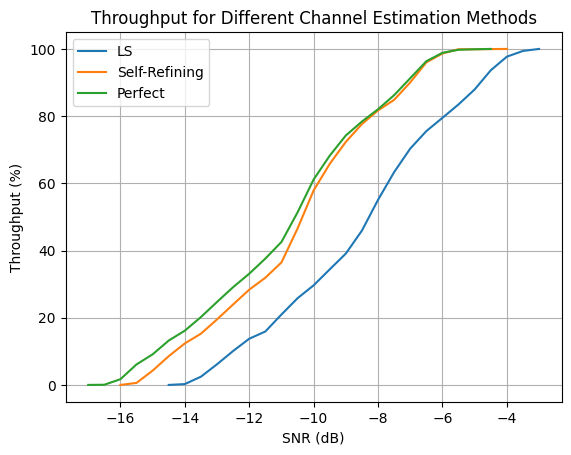
The evaluation compares multiple channel estimation methods, including the trained neural network and conventional estimation techniques, within a complete communication pipeline. When decoding errors occur, HARQ retransmissions are used to recover the transmitted data. The throughput achieved by each method is then calculated by accounting for both successful transmissions and the retransmissions required to achieve reliable communication.
Unlike the NMSE evaluation, which measures channel estimation accuracy, and the BLER evaluation, which measures decoding reliability, the HARQ evaluation provides a system-level performance metric that reflects the practical efficiency of the receiver. The resulting throughput curves demonstrate how improvements in channel estimation translate into increased data rates under realistic communication conditions.
[1]:
import numpy as np
import time, os, torch
import matplotlib.pyplot as plt

from neoradium import BandwidthPart, PDSCH, CdlChannel, AntennaPanel, random, SnrScheduler

from ChEstNet import ChEstNet
from ChEstUtils import estimateChannelML, getPseudoPilotIndices
[2]:
# Load the trained model
modelPath = 'Models/Pretrained.pth'                      # Use the pre-trained model
# modelPath = 'Models/Trained.pth'                        # Use the model trained in the previous step (see MLChEstTrain.ipynb)
device = "cuda:0" if torch.cuda.is_available() else "mps" if torch.backends.mps.is_available() else "cpu"
model = ChEstNet(device)                                # Instantiate the model on the target device
model.loadParams(modelPath);                            # Load the trained model parameters
[3]:
# Calculate communication throughput with HARQ
seed = 123
# Note:
# Using maxSlots = 2000 may cause this experiment to take a long time to complete.
# You can use a smaller value to obtain quicker (though less precise) results. You may
# also use a larger increments for the 'SnrScheduler' below for a coarser set of SNR values.
maxSlots = 2000                                 # Number of slots
snrScheduler = SnrScheduler(-13,0.5,fastStep=1) # Start at -13 dB, use increments of 0.5 dB
bwp = BandwidthPart(numRbs=45, spacing=30)      # Create a BandwidthPart object


# Create a two-layer PDSCH object with type-2 DMRS on symbols 2 and 11
pdsch = PDSCH(bwp, numLayers=2, modulation="16QAM")
pdsch.setDMRS(configType=2, additionalPos=1)

# Create the HARQ entity and its internal LDPC codec object
harq = pdsch.getHarq(coderates=490/1024,        # Coderate used by the LDPC codec
                     numIter=2,                 # Same as the paper (Default is 5)
                     harqType="CC",             # Use chase combining (CC)
                     numProc=16)                # Number of HARQ processes

# Create the channel model
channel = CdlChannel(bwp, 'C', delaySpread=300, carrierFreq=4e9, dopplerShift=5,
                     txAntenna = AntennaPanel([2,4], polarization="x"),  # 16 TX antennas
                     rxAntenna = AntennaPanel([1,2], polarization="x"))  # 4 RX antennas

def equalizeAndDecode(rxGrid, chanEst, errVar=None):
    eqGrid, llrScales = pdsch.equalize(rxGrid, chanEst, errVar)         # Equalization
    llrs = pdsch.getLLRs(eqGrid, llrScales)                             # Demodulation (to LLRs)
    # This is important:
    # During the refinement loop, decoding must use the HARQ decode buffer for
    # retransmissions without modifying the HARQ state. To do this, we save the
    # current HARQ decode buffer, call the LDPC decoder with the HarqCW object so
    # that it uses the HARQ buffer, and then restore the saved buffer. This allows
    # the decoder to use the HARQ combining state while leaving the HARQ object
    # unchanged.
    harqCw = harq.curProcess.cws[0]     # Since we have 2 layers, there is only one codeword
    savedBuffer = None if harqCw.decBuffer is None else np.copy(harqCw.decBuffer)   # Save HARQ buffer
    decodedTxBlock, crcMatch = harqCw.ldpcCodec.decode(llrs[0], harqCw)             # LDPC decoding
    harqCw.decBuffer = savedBuffer                                                  # Restore HARQ buffer

    cbErrors = (crcMatch[1:]==False).sum()                              # Number of code block errors
    return [cbErrors, len(crcMatch)-1], [decodedTxBlock, crcMatch]

chEstMethods = ["LS", "Self-Refining", "Perfect"]
results = {}

for chEstMethod in chEstMethods:
    print(f'\nEvaluating throughput with {chEstMethod} channel {"knowledge" if chEstMethod=='Perfect' else "estimation"}')
    print("SNR(dB)  Tx Bits     Rx Bits     Throughput(%)  TX Blocks  RX Blocks  BLER(%)  Avg. Retransmissions  time(Sec.)")
    print("-------  ----------  ----------  -------------  ---------  ---------  -------  --------------------  ----------")

    snrScheduler.reset()
    for snrDb in snrScheduler:
        random.setSeed(seed)
        channel.restart()                                           # Reset the channel and the bandwidth part
        harq.reset()                                                # Reset HARQ state and buffers
        retransmissionsSaved = 0

        t0 = time.monotonic()                                       # Start the timer
        for s in range(maxSlots):                                   # The inner loop doing 'numSlot' transmissions
            pdsch.initGrid()                                        # Create and initialize PDSCH's internal grid
            numBits = pdsch.getBitCapacity()[0]                     # Number of bits available in the resource grid
            tbs = harq.ldpcCodec.txBlockSizes                       # Transport block sizes (for each codeword)

            # Preparing the transport blocks
            txBlocks = []                                           # Transport blocks, one per codeword.
            for c in range(harq.numCW):
                if harq.needNewData[c]: txBlocks += [ random.bits(tbs[c]) ] # Create random bits for new transmissions
                else:                   txBlocks += [ None ]                # Set to None indicating a retransmission

            # The 'harq.encode' function returns a coded, rate-matched bitstream, ready for transmission/retransmission
            rateMatchedCBs = harq.encode(txBlocks, numBits)
            pdsch.setPdschData(rateMatchedCBs)                      # Map/modulate the data to the resource grid

            channelMatrix = channel.getChannelMatrix()              # Get perfect channel matrix
            precoder = pdsch.getPrecodingMatrix(channelMatrix)      # Get precoding matrix

            txGrid = bwp.createGrid(channelMatrix.shape[3])         # Create the transmitted resource grid
            pdsch.precodeTo(txGrid, precoder)                       # Precode PDSCH data into the txGrid

            rxGrid = txGrid.applyChannel(channelMatrix)             # Apply the channel in the frequency domain
            noisyRxGrid = rxGrid.addNoise(snrDb=snrDb)              # Add noise

            errVar = None                                           # Only used for LS channel estination
            if chEstMethod == "Perfect":
                pcChannelMatrix = channel.getEffChannel(channelMatrix, precoder)    # Ground-truth effective channel

            elif chEstMethod == "LS":
                pcChannelMatrix, errVar = pdsch.estimateChannel(noisyRxGrid)        # LS channel estimation using DMRS

            elif chEstMethod == "Self-Refining":
                # ML channel estimation using DMRS only
                dmrsIdx = pdsch.grid.getReIndexes("DMRS")
                pcChannelMatrix = estimateChannelML(model, dmrsIdx, pdsch.grid, noisyRxGrid)
                blerInfo, decodeInfo = equalizeAndDecode(noisyRxGrid, pcChannelMatrix)

                cbErrors, numCB = blerInfo
                decodedTxBlock, crcMatch = decodeInfo
                # Now try using pseudo-pilots
                # Pseudo-pilots are relevant only when cbErrors ∈ {1,...,numCB-1}
                relevantCbErrors = np.arange(1,numCB)
                orgCbErrors = cbErrors
                while cbErrors in relevantCbErrors:
                    pseudoPilotIndices = getPseudoPilotIndices(pdsch, harq.ldpcCodec, decodedTxBlock, crcMatch)
                    allPilotIndices = tuple(np.append(pseudoPilotIndices[i],dmrsIdx[i]) for i in [0,1,2])
                    pcChannelMatrix = estimateChannelML(model, allPilotIndices, pdsch.grid, noisyRxGrid)

                    blerInfo, decodeInfo = equalizeAndDecode(noisyRxGrid, pcChannelMatrix)
                    if blerInfo[0] >= cbErrors: break          # No improvement or getting worse
                    cbErrors = blerInfo[0]
                    decodedTxBlock, crcMatch = decodeInfo

                retransmissionsSaved += 1*(cbErrors==0 and orgCbErrors>0)

            # Use the channel matrix (with precoding effect) to equalize the received resource grid
            eqGrid, llrScales = pdsch.equalize(noisyRxGrid, pcChannelMatrix, errVar)

            # Demodulate the equalized resource grid (eqGrid) to get the Log-Likelihood values
            llrs = pdsch.getLLRs(eqGrid, llrScales)

            # Use HARQ entity to decode the LLRs to transport blocks
            decodedTxBlocks, crcMatches = harq.decode(llrs)

            # Get the statistics from HARQ entity and print them:
            print(f"{snrDb:^7.2f}  {harq.totalTxBits:^10d}  {harq.totalRxBits:^10d}  {harq.throughput:^13.2f}  "
              f"{harq.totalTxBlocks:^9}  {harq.totalRxBlocks:^9d}  {harq.bler:^7.2f}  {harq.meanRetransmissions:^20.3f}  "
              f"{time.monotonic()-t0:^-10.3f}", end="\r")

            channel.goNext()
            harq.goNext()

        snrScheduler.setData(harq.bler, harq.throughput)
        print("")

    results[chEstMethod] = snrScheduler.getSnrsAndData()
Evaluating throughput with LS channel estimation
SNR(dB)  Tx Bits     Rx Bits     Throughput(%)  TX Blocks  RX Blocks  BLER(%)  Avg. Retransmissions  time(Sec.)
-------  ----------  ----------  -------------  ---------  ---------  -------  --------------------  ----------
-13.00    53264000    3275736        6.15         2000        123      93.85          2.980           136.885
-13.50    53264000    1304968        2.45         2000        49       97.55          3.000           139.063
-14.00    53264000     133160        0.25         2000         5       99.75          3.000           137.812
-14.50    53264000       0           0.00         2000         0      100.00          3.000           136.565
-15.00    53264000       0           0.00         2000         0      100.00          3.000           138.182
-12.50    53264000    5379664        10.10        2000        202      89.90          2.865           137.414
-12.00    53264000    7323800        13.75        2000        275      86.25          2.669           138.908
-11.50    53264000    8468976        15.90        2000        318      84.10          2.526           139.550
-11.00    53264000    11158808       20.95        2000        419      79.05          2.192           140.443
-10.50    53264000    13742112       25.80        2000        516      74.20          1.893           139.696
-10.00    53264000    15792776       29.65        2000        593      70.35          1.732           139.077
 -9.50    53264000    18322816       34.40        2000        688      65.60          1.578           138.679
 -9.00    53264000    20826224       39.10        2000        782      60.90          1.447           136.705
 -8.50    53264000    24474808       45.95        2000        919      54.05          1.141           139.230
 -8.00    53264000    29348464       55.10        2000       1102      44.90          0.795           144.822
 -7.50    53264000    33742744       63.35        2000       1267      36.65          0.565           150.803
 -7.00    53264000    37471224       70.35        2000       1407      29.65          0.414           147.850
 -6.50    53264000    40240952       75.55        2000       1511      24.45          0.321           150.201
 -6.00    53264000    42344880       79.50        2000       1590      20.50          0.252           151.231
 -5.50    53264000    44475440       83.50        2000       1670      16.50          0.195           151.334
 -5.00    53264000    46845688       87.95        2000       1759      12.05          0.133           151.945
 -4.50    53264000    49881736       93.65        2000       1873      6.35           0.067           154.868
 -4.00    53264000    52038928       97.70        2000       1954      2.30           0.023           157.392
 -3.50    53264000    52944416       99.40        2000       1988      0.60           0.006           160.628
 -3.00    53264000    53264000      100.00        2000       2000      0.00           0.000           159.955
 -2.50    53264000    53264000      100.00        2000       2000      0.00           0.000           151.069

Evaluating throughput with Self-Refining channel estimation
SNR(dB)  Tx Bits     Rx Bits     Throughput(%)  TX Blocks  RX Blocks  BLER(%)  Avg. Retransmissions  time(Sec.)
-------  ----------  ----------  -------------  ---------  ---------  -------  --------------------  ----------
-13.00    53264000    10386480       19.50        2000        390      80.50          2.252           230.415
-13.50    53264000    8122760        15.25        2000        305      84.75          2.559           223.325
-14.00    53264000    6578104        12.35        2000        247      87.65          2.736           226.205
-14.50    53264000    4554072        8.55         2000        171      91.45          2.917           216.346
-15.00    53264000    2263720        4.25         2000        85       95.75          3.000           211.061
-15.50    53264000     319584        0.60         2000        12       99.40          3.000           205.106
-16.00    53264000       0           0.00         2000         0      100.00          3.000           201.597
-16.50    53264000       0           0.00         2000         0      100.00          3.000           205.833
-12.50    53264000    12756728       23.95        2000        479      76.05          1.964           230.617
-12.00    53264000    15100344       28.35        2000        567      71.65          1.740           224.649
-11.50    53264000    16991216       31.90        2000        638      68.10          1.596           225.135
-11.00    53264000    19414728       36.45        2000        729      63.55          1.461           235.764
-10.50    53264000    24794392       46.55        2000        931      53.45          1.084           259.264
-10.00    53264000    30839856       57.90        2000       1158      42.10          0.707           260.070
 -9.50    53264000    35047712       65.80        2000       1316      34.20          0.514           243.706
 -9.00    53264000    38536504       72.35        2000       1447      27.65          0.373           246.932
 -8.50    53264000    41359496       77.65        2000       1553      22.35          0.285           251.182
 -8.00    53264000    43516688       81.70        2000       1634      18.30          0.220           247.396
 -7.50    53264000    45194504       84.85        2000       1697      15.15          0.174           244.450
 -7.00    53264000    47964232       90.05        2000       1801      9.95           0.109           243.108
 -6.50    53264000    51133440       96.00        2000       1920      4.00           0.040           247.484
 -6.00    53264000    52544936       98.65        2000       1973      1.35           0.013           240.270
 -5.50    53264000    53210736       99.90        2000       1998      0.10           0.001           232.940
 -5.00    53264000    53210736       99.90        2000       1998      0.10           0.001           227.921
 -4.50    53264000    53237368       99.95        2000       1999      0.05           0.001           227.535
 -4.00    53264000    53264000      100.00        2000       2000      0.00           0.000           231.226
 -3.50    53264000    53264000      100.00        2000       2000      0.00           0.000           233.201

Evaluating throughput with Perfect channel knowledge
SNR(dB)  Tx Bits     Rx Bits     Throughput(%)  TX Blocks  RX Blocks  BLER(%)  Avg. Retransmissions  time(Sec.)
-------  ----------  ----------  -------------  ---------  ---------  -------  --------------------  ----------
-13.00    53264000    13156208       24.70        2000        494      75.30          1.965           130.573
-13.50    53264000    10759328       20.20        2000        404      79.80          2.292           128.761
-14.00    53264000    8602136        16.15        2000        323      83.85          2.556           124.201
-14.50    53264000    7030848        13.20        2000        264      86.80          2.683           123.129
-15.00    53264000    4847024        9.10         2000        182      90.90          2.913           122.379
-15.50    53264000    3249104        6.10         2000        122      93.90          3.000           124.260
-16.00    53264000     905488        1.70         2000        34       98.30          3.000           125.119
-16.50    53264000     26632         0.05         2000         1       99.95          3.000           127.088
-17.00    53264000       0           0.00         2000         0      100.00          3.000           128.885
-17.50    53264000       0           0.00         2000         0      100.00          3.000           127.140
-12.50    53264000    15499824       29.10        2000        582      70.90          1.756           127.492
-12.00    53264000    17630384       33.10        2000        662      66.90          1.623           129.133
-11.50    53264000    20027264       37.60        2000        752      62.40          1.486           130.548
-11.00    53264000    22663832       42.55        2000        851      57.45          1.301           130.929
-10.50    53264000    27351064       51.35        2000       1027      48.65          0.932           134.249
-10.00    53264000    32570936       61.15        2000       1223      38.85          0.620           137.291
 -9.50    53264000    36352680       68.25        2000       1365      31.75          0.457           142.902
 -9.00    53264000    39548520       74.25        2000       1485      25.75          0.341           146.863
 -8.50    53264000    41758976       78.40        2000       1568      21.60          0.270           147.214
 -8.00    53264000    43703112       82.05        2000       1641      17.95          0.214           148.667
 -7.50    53264000    45940200       86.25        2000       1725      13.75          0.157           140.724
 -7.00    53264000    48630032       91.30        2000       1826      8.70           0.093           140.073
 -6.50    53264000    51319864       96.35        2000       1927      3.65           0.037           140.369
 -6.00    53264000    52651464       98.85        2000       1977      1.15           0.012           142.829
 -5.50    53264000    53130840       99.75        2000       1995      0.25           0.003           145.549
 -5.00    53264000    53210736       99.90        2000       1998      0.10           0.001           147.813
 -4.50    53264000    53264000      100.00        2000       2000      0.00           0.000           147.261
 -4.00    53264000    53264000      100.00        2000       2000      0.00           0.000           145.654
[4]:
for i,chEstMethod in enumerate(results.keys()):
    plt.plot(results[chEstMethod][0], results[chEstMethod][2], label=chEstMethod)
plt.legend()
plt.title("Throughput for Different Channel Estimation Methods")
plt.grid()
plt.xlabel("SNR (dB)")
plt.ylabel("Throughput (%)")
plt.show()
[ ]:
[ ]:
[ ]: