Evaluating End-to-End Communication Performance Using BLER
This notebook evaluates the trained channel estimation model within a complete end-to-end communication pipeline using Block Error Rate (BLER) as the performance metric. Unlike the NMSE evaluation, which measures channel estimation accuracy directly, BLER quantifies the impact of channel estimation on the successful decoding of transmitted data.
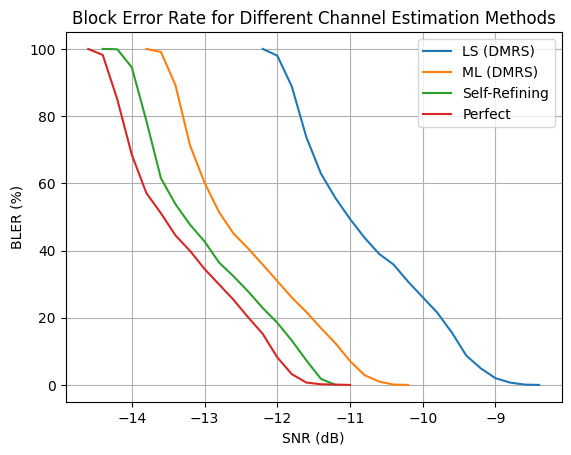
The evaluation compares several channel estimation approaches across a range of signal-to-noise ratio (SNR) values, including the trained neural network and conventional estimation methods. For each SNR value, the communication system transmits multiple transport blocks, performs channel estimation and decoding, and records the resulting BLER.
The generated BLER curves provide a practical measure of receiver performance and illustrate how improvements in channel estimation translate into improved communication reliability.
[1]:
import numpy as np
import time, os, torch
import matplotlib.pyplot as plt

from neoradium import BandwidthPart, PDSCH, CdlChannel, AntennaPanel, random, SnrScheduler

from ChEstNet import ChEstNet
from ChEstUtils import estimateChannelML, getPseudoPilotIndices
[2]:
# Load the trained model
modelPath = 'Models/Pretrained.pth'                      # Use the pre-trained model
# modelPath = 'Models/Trained.pth'                        # Use the model trained in the previous step (see MLChEstTrain.ipynb)
device = "cuda:0" if torch.cuda.is_available() else "mps" if torch.backends.mps.is_available() else "cpu"
model = ChEstNet(device)                                # Instantiate the model on the target device
model.loadParams(modelPath);                            # Load the trained model parameters
[3]:
# Calculate block error rates (BLER)
seed = 123

# Using maxSlots = 1000 may cause this experiment to take a long time to complete.
# You can use a smaller value to obtain quicker (though less precise) results.
maxSlots = 1000                                     # Number of Slots
snrScheduler = SnrScheduler(-12,0.2, fastStep=1)    # Start at -13 dB, use increments of 0.2 dB

freqDomain = True                                   # Apply channel in frequency domain
modulation = "16QAM"
numLayers = 2

bwp = BandwidthPart(numRbs=45, spacing=30)  # Create a BandwidthPart object

# Create a two-layer PDSCH object with type-2 DMRS on symbols 2 and 11
pdsch = PDSCH(bwp, numLayers=numLayers, modulation=modulation)
pdsch.setDMRS(configType=2, additionalPos=1) # DMRS configuration

# Create the LDPC codec
# Note: The code that generated the results in the paper used LDPC numIter=20. Here
# we use the default value, numIter=5. Therefore, the results here may be
# slightly worse than those reported in the paper.
ldpc = pdsch.getLdpcCodec(coderates=490/1024)
channel = CdlChannel(bwp, 'C', delaySpread=300, carrierFreq=4e9, dopplerShift=5,
                     txAntenna = AntennaPanel([2,4], polarization="x"), # 16 TX antennas
                     rxAntenna = AntennaPanel([1,2], polarization="x")) # 4 RX antennas

def equalizeAndDecode(rxGrid, chanEst, errVar=None):
    eqGrid, llrScales = pdsch.equalize(rxGrid, chanEst, errVar)         # Equalization
    llrs = pdsch.getLLRs(eqGrid, llrScales)                             # Demodulation (to LLRs)
    decodedTxBlock, crcMatch = ldpc.decode(llrs[0])                     # LDPC decoding

    cbErrors = (crcMatch[1:]==False).sum()                              # Number of code block errors
    return [cbErrors, len(crcMatch)-1], [decodedTxBlock, crcMatch]

chEstMethods = ["LS (DMRS)", "ML (DMRS)", "Self-Refining", "Perfect"]
results = {}

for chEstMethod in chEstMethods:
    print(f'\nEvaluating BLER with {chEstMethod} channel {"knowledge" if chEstMethod=='Perfect' else "estimation"}')
    if chEstMethod=="Self-Refining":
        print("SNR(dB)  TX Blocks  Block Errors  BLER(%)  Ret. Saved  Rec. Code Blocks")
        print("-------  ---------  ------------  -------  ----------  ----------------")
    else:
        print("SNR(dB)  TX Blocks  Block Errors  BLER(%)")
        print("-------  ---------  ------------  -------")

    snrScheduler.reset()
    for snrDb in snrScheduler:
        random.setSeed(seed)
        channel.restart()                                           # Reset the channel and the bandwidth part

        totalRetransmissions = 0
        retransmissionsSaved = 0
        codeBlocksRecovered = 0

        t0 = time.time()                                            # Start the timer
        blockErrors = 0
        totalBlocks = 0
        for s in range(maxSlots):                                   # The inner loop doing 'numSlot' transmissions
            pdsch.initGrid()                                        # Create and initialize PDSCH's internal grid
            numBits = pdsch.getBitCapacity()[0]                     # Number of bits available in the resource grid
            txBlock = random.bits(ldpc.txBlockSizes[0])             # Create random transport block
            rateMatchedCBs = ldpc.encode(txBlock, numBits)

            pdsch.setPdschData(rateMatchedCBs)                      # Map/modulate the data to the resource grid

            channelMatrix = channel.getChannelMatrix()              # Get the channel matrix
            precoder = pdsch.getPrecodingMatrix(channelMatrix)      # Get the precoder matrix from the PDSCH object
            perfectChannel = channel.getEffChannel(channelMatrix, precoder) # Get ground-truth effective channel
            txGrid = bwp.createGrid(channelMatrix.shape[3])         # Create the transmitted resource grid
            pdsch.precodeTo(txGrid, precoder)                       # Precode PDSCH data into the txGrid

            if freqDomain:
                rxGrid = txGrid.applyChannel(channelMatrix)         # Apply the channel in the frequency domain
                noisyRxGrid = rxGrid.addNoise(snrDb=snrDb)          # Add noise in the frequency domain
            else:
                txWaveform = txGrid.ofdmModulate()                  # OFDM modulation
                maxDelay = channel.getMaxDelay()                    # Calculate the maximum channel delay
                txWaveform = txWaveform.pad(maxDelay)               # Pad the waveform with zeros
                rxWaveform = channel.applyToSignal(txWaveform)      # Apply the channel to the waveform
                noisyRxWaveform = rxWaveform.addNoise(snrDb=snrDb, bwp=bwp) # Add noise
                offset = channel.getTimingOffset()                  # Get the timing offset for synchronization
                syncedWaveform = noisyRxWaveform.sync(offset)       # Synchronize the received waveform
                noisyRxGrid = syncedWaveform.ofdmDemodulate(bwp)    # OFDM-demodulate the synchronized waveform

            if chEstMethod=="LS (DMRS)":
                # LS channel estimation using DMRS
                lsChannelMatrix, errVar = pdsch.estimateChannel(noisyRxGrid)
                blerInfo, (decodedTxBlock, crcMatch) = equalizeAndDecode(noisyRxGrid, lsChannelMatrix, errVar)

            elif chEstMethod=="ML (DMRS)":
                # ML channel estimation using DMRS only
                dmrsIdx = pdsch.grid.getReIndexes("DMRS")
                mlChannelMatrix = estimateChannelML(model, dmrsIdx, pdsch.grid, noisyRxGrid)
                blerInfo, (decodedTxBlock, crcMatch) = equalizeAndDecode(noisyRxGrid, mlChannelMatrix)

            elif chEstMethod=="Self-Refining":
                dmrsIdx = pdsch.grid.getReIndexes("DMRS")
                mlChannelMatrix = estimateChannelML(model, dmrsIdx, pdsch.grid, noisyRxGrid)
                blerInfo, (decodedTxBlock, crcMatch) = equalizeAndDecode(noisyRxGrid, mlChannelMatrix)

                cbErrors, numCB = blerInfo
                # Now try using pseudo-pilots
                # Pseudo-pilots are relevant only when cbErrors ∈ {1,...,numCB-1}
                relevantCbErrors = np.arange(1,numCB)
                orgCbErrors = cbErrors
                while cbErrors in relevantCbErrors:
                    pseudoPilotIndices = getPseudoPilotIndices(pdsch, ldpc, decodedTxBlock, crcMatch)
                    allPilotIndices = tuple(np.append(pseudoPilotIndices[i],dmrsIdx[i]) for i in [0,1,2])
                    mlChannelMatrix = estimateChannelML(model, allPilotIndices, pdsch.grid, noisyRxGrid)

                    blerInfo, (decodedTxBlock, crcMatch) = equalizeAndDecode(noisyRxGrid, mlChannelMatrix)
                    if blerInfo[0] >= cbErrors: break   # No improvement
                    cbErrors = blerInfo[0]

                totalRetransmissions += 1*(orgCbErrors in relevantCbErrors) # The retransmissions that could be saved
                codeBlocksRecovered  += orgCbErrors - cbErrors
                retransmissionsSaved += 1*(cbErrors==0 and orgCbErrors>0)

            elif chEstMethod=="Perfect":
                blerInfo, (decodedTxBlock, crcMatch) = equalizeAndDecode(noisyRxGrid, perfectChannel)

            channel.goNext()                        # Prepare the channel model for the next slot
            blockErrors += 0 if crcMatch[0] else 1
            totalBlocks += 1
            bler = blockErrors*100/totalBlocks
            print(f"\r{snrDb:7.1f}  {totalBlocks:9,d}  {blockErrors:12,d}  {bler:7.2f}  " +
                  (f"{retransmissionsSaved:10,d} {codeBlocksRecovered:17,d}" if chEstMethod=="Self-Refining" else ""), end='')

        snrScheduler.setData(bler)
        print("")

    results[chEstMethod] = snrScheduler.getSnrsAndData()
Evaluating BLER with LS (DMRS) channel estimation
SNR(dB)  TX Blocks  Block Errors  BLER(%)
-------  ---------  ------------  -------
  -12.0      1,000           980    98.00
  -12.2      1,000         1,000   100.00
  -12.4      1,000         1,000   100.00
  -11.8      1,000           888    88.80
  -11.6      1,000           737    73.70
  -11.4      1,000           629    62.90
  -11.2      1,000           556    55.60
  -11.0      1,000           494    49.40
  -10.8      1,000           438    43.80
  -10.6      1,000           390    39.00
  -10.4      1,000           358    35.80
  -10.2      1,000           307    30.70
  -10.0      1,000           261    26.10
   -9.8      1,000           215    21.50
   -9.6      1,000           156    15.60
   -9.4      1,000            87     8.70
   -9.2      1,000            49     4.90
   -9.0      1,000            20     2.00
   -8.8      1,000             7     0.70
   -8.6      1,000             1     0.10
   -8.4      1,000             0     0.00
   -8.2      1,000             0     0.00

Evaluating BLER with ML (DMRS) channel estimation
SNR(dB)  TX Blocks  Block Errors  BLER(%)
-------  ---------  ------------  -------
  -12.0      1,000           309    30.90
  -12.2      1,000           358    35.80
  -12.4      1,000           406    40.60
  -12.6      1,000           450    45.00
  -12.8      1,000           514    51.40
  -13.0      1,000           602    60.20
  -13.2      1,000           713    71.30
  -13.4      1,000           892    89.20
  -13.6      1,000           991    99.10
  -13.8      1,000         1,000   100.00
  -14.0      1,000         1,000   100.00
  -11.8      1,000           260    26.00
  -11.6      1,000           217    21.70
  -11.4      1,000           169    16.90
  -11.2      1,000           124    12.40
  -11.0      1,000            71     7.10
  -10.8      1,000            29     2.90
  -10.6      1,000            10     1.00
  -10.4      1,000             1     0.10
  -10.2      1,000             0     0.00
  -10.0      1,000             0     0.00

Evaluating BLER with Self-Refining channel estimation
SNR(dB)  TX Blocks  Block Errors  BLER(%)  Ret. Saved  Rec. Code Blocks
-------  ---------  ------------  -------  ----------  ----------------
  -12.0      1,000           185    18.50         124               248
  -12.2      1,000           229    22.90         129               254
  -12.4      1,000           278    27.80         128               249
  -12.6      1,000           323    32.30         128               241
  -12.8      1,000           364    36.40         150               295
  -13.0      1,000           427    42.70         175               296
  -13.2      1,000           477    47.70         236               395
  -13.4      1,000           538    53.80         355               605
  -13.6      1,000           615    61.50         376               815
  -13.8      1,000           786    78.60         214               582
  -14.0      1,000           945    94.50          55               186
  -14.2      1,000           999    99.90           1                10
  -14.4      1,000         1,000   100.00           0                 0
  -14.6      1,000         1,000   100.00           0                 0
  -11.8      1,000           132    13.20         128               280
  -11.6      1,000            73     7.30         144               313
  -11.4      1,000            18     1.80         151               285
  -11.2      1,000             0     0.00         124               205
  -11.0      1,000             0     0.00          71                88

Evaluating BLER with Perfect channel knowledge
SNR(dB)  TX Blocks  Block Errors  BLER(%)
-------  ---------  ------------  -------
  -12.0      1,000            82     8.20
  -12.2      1,000           152    15.20
  -12.4      1,000           201    20.10
  -12.6      1,000           253    25.30
  -12.8      1,000           299    29.90
  -13.0      1,000           345    34.50
  -13.2      1,000           399    39.90
  -13.4      1,000           445    44.50
  -13.6      1,000           511    51.10
  -13.8      1,000           571    57.10
  -14.0      1,000           685    68.50
  -14.2      1,000           850    85.00
  -14.4      1,000           982    98.20
  -14.6      1,000         1,000   100.00
  -14.8      1,000         1,000   100.00
  -11.8      1,000            32     3.20
  -11.6      1,000             7     0.70
  -11.4      1,000             2     0.20
  -11.2      1,000             1     0.10
  -11.0      1,000             0     0.00
  -10.8      1,000             0     0.00
[4]:
for i,chEstMethod in enumerate(chEstMethods):
    snrDbs, blers = results[chEstMethod]
    plt.plot(snrDbs, blers, label=chEstMethod)
plt.legend()
plt.title("Block Error Rate for Different Channel Estimation Methods")
plt.grid()
plt.xlabel("SNR (dB)")
plt.ylabel("BLER (%)")
plt.show()
[ ]: